TABLE OF CONTENTS


GENERAL INFORMATION


Disclaimer: The statements and opinions contained in the articles of the American College of Osteopathic Pediatricians’ (ACOP) eJournal are solely those of the individual authors and contributors and not necessarily those of the ACOP. The appearance of advertisements in the ACOP eJournal is not a warranty, endorsement or approval of the products or services advertised or their effectiveness, quality or safety. The ACOP disclaims responsibility for any injury and/or damage to persons or property as a matter of products liability, negligence, or otherwise, or from any use of operation or any methods, products, instructions, or ideas contained in the material herein. Discussions, views, and recommendations as to medical procedures, choice of drugs, and drug dosages are the responsibility of the authors.

From the
AOBP Board Chairman

The AOBP receives frequent inquiries regarding courses or materials to be used in preparation to take the certification exam. Neither the ACOP nor the AOBP offer or require that a candidate take a board review course prior to sitting for the certification exam.  It is the policy of the AOBP to not endorse any preparatory course or study materials. Many quality courses and materials are available to the candidate to aid in preparation for the certification exam. Each has positive attributes and the candidate may consider enrolling in a board review course or purchasing study guides. There can be, of course, no guarantee that using these guides or courses will guarantee a passing grade. Each candidate should prepare for the exam using study techniques developed by the individual which have proven effective for them in the past.

The ACOP has generously provided space in this e-Journal to publish review articles which will cover topics that impact the daily activities of the general pediatrician. Each edition will feature a review of new issues, changing practices and common pediatric illnesses of interest to the modern osteopathic pediatrician. Colleagues who are experts in their fields will be asked to develop and publish these reviews in this e-Journal. It is not possible to provide a comprehensive board review in a quarterly publication nor is it intended that this section will substitute for individual preparation for the boards.

Please visit the AOBP website at www.aobp.org for more information about the certification and recertification process. In addition to General Pediatrics, the AOBP offers a Certificate of Special Qualifications in five subspecialty areas: Neonatology, Pediatric Allergy/Immunology, Pediatric Endocrinology, Pediatric Pulmonary Medicine & Adolescent Medicine. A Certificate of Added Qualifications is also offered in Sports Medicine. Applications may be downloaded and the dates and sites of upcoming examinations are published here. Support services for the AOBP are provided by the AOA Certifying Board Services in Chicago, IL. The director of CBS is Ellen Woods. You may speak directly with Ellie Kraynak at 1-800-621-1773, extension 8195 if you have more questions.

Good luck in your endeavor to achieve or maintain your certification!

Fernando Gonzalez, DO, FACOP, FAAP
Chairman, AOBP


PLAN NOW!66th Annual Mtg
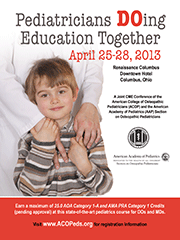
Pediatricians
DOing Education Together
April 25-28, 2013
Renaisance Columbus Downtown Hotel
Columbus, OH


Osteopathic Continuous Certification
AOBP CME Questions for Winter 2013 – Answer Submission

AOA Category 1-B CME credit is NO LONGER AVAILABLE for completing this quiz.

Full Name
   
Please choose ONE answer for each question and submit this form using the button below. Your answers will be checked for accuracy and you will receive the results via email in no more that 5 business days.
1. The four basic conceptual ideas that any clinician must keep in mind that will cover the general osteopathic management of URIs with pediatric patients are:
A. Release of the thoracic inlet, and other related physiologic facial diaphragms
B.  Treatment of the cervico-thoracic dysfuctions
C.  Sinus and lymphatic drainage
D.  Treatment of the corresponding Chapman reflex points
E. All of the above
2. The thoracic inlet is formed by all of the following except:
A. The fifth to seventh rib
B.  The manubrium
C. The first four thoracic vertebrae
D. Fascia from the scalenius muscle
E. Fascia from the longus coli muscle
3. Structural exam finding for an URTI may include all of the following except:
A. Limited range of motion with side bending and rotational aspect of the clavicles
B. Tight musculature of the neck and upper back
C. Corresponding Chapman points on the anterior of the patient.
D. Solar plexus estability
E. Tender swollen upper lymphatics
4. Dysfunction of the thoracic inlet can be treated with myofacial release both direct and indirectly.
A. True
B. False
5. Which of the following techniques are useful in treating eustachian tube dysfunction?
A. Galbreath.
B. Auricular Drainage
C. Maxillary Effleurage
D. Trigeminal stimulation
E. Both A & B
6. Risk Factors for LRTI in Pediatric Patients include all of the following except:
A. Cold winter months
B. Environmental crowding
C. Female (1.25:1 to 2:1)
D. School-aged siblings
E. Cigarette usage or cigarette smoke exposure
7. The most common bacterial pathogen causing LRTI in children older than five years of age is Streptococcus pneumonae.
A. True
B. False
8. In LRTI, somatic tissue texture changes occur at which thoracic vertebra level.
A. 4
B. 5
C. 6
D. 7
E. 8
9. Osteopathic examination of patients with LRTI include all except:
A. Occipital-atlas, atlas-axial, cranium (Vagus nerve)
B. Cervical spine 1-2 (Phrenic nerve)
C. Sternum
D. Thoracic inlet/Cervico-thoracic junction (Lympathics)
E. Thoracic spine 1-12 and Ribs 1-12 (Somatic nerves, lympathics, sympathetic, and respiration)
10. To improve diaphragmatic movement one could treat C3-C4.
A. True
B. False