|
||||||||||
Four Case Reports on Major
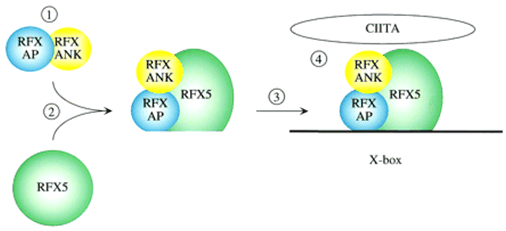
Introduction Major histocompatibility complex (MCH) class II deficiency, also known as bare lymphocyte syndrome type 2, is a rare combined immunodeficiency disease.(1) It is primarily found in infants born in the Kingdom of Saudi Arabia. We have investigated four children with MHC class II deficiency. Two have received bone marrow allogenic stem cell transplant. This rare combined immunodeficiency disease is characterized by an absence of human leukocyte antigen (HLA) class II expression. The lack of expression is caused at the transcription level by a defect in the one of the four regulatory factors: CIITA, RFXANK, RFX5 and RFXAP.(1) The latter three form a heterotrimeric RFX complex (Figure 1). Mutation of the RFXANK factor is the most common of the four regulatory factors. The disease is autosomal recessive for all four regulatory factors and results in a decrease in cellular and humoral immune response to foreign antigens.
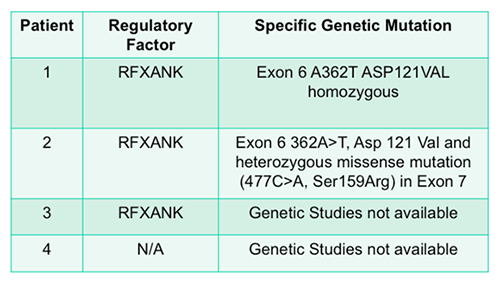
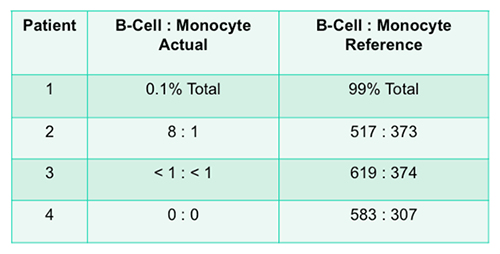
Global reduction in immune response leaves the individual susceptible to infection from virtually all pathogens (viral, bacterial, fungal and protozoa). Infections are mainly in the respiratory and/or gastrointestinal tracks. Natural course of this disease results in early age fatalities that are often caused by severe malabsorption with failure to survive. To date the only hope for cure is allogenic hematopoietic stem cell transplant (HSCT). However, MCH class II deficiency carries a lower survival rate than other primary immunodeficiencies. This has been attributed to several factors such as, preexisting viral infections and long term persistence of CD4 T cell lymphopenia.(3) Case Reports Patient one (27-month-old female), patient two (22-month-old female), and patient three (18-month old male) presented with a history of recurrent respiratory infections followed by gastrointestinal infections and failure to thrive. Patient four (12-month-old female) was screened due to family history at three weeks of life for bare lymphocyte syndrome.  Selected Extended Histories: Patient one is a 27-month-old female from Saudi Arabia with confirmed MHC II deficiency by genetic analysis (Table 1) and flow cytometry (Table 2). She was born full term with no complications to a 30-year-old women. She was reported healthy until six months of age when signs of an upper respiratory illness developed. Other subsequent illnesses include: non- infectious hepatitis, hemolytic anemia, chronic diarrhea, skin infection/impetigo, oral and esophageal candidiasis, Moraxella Catarrhalis pneumonia, bilateral otitis media and sinusitis. Patient two is a 22-month-old female from Saudi Arabia with confirmed MHC II deficiency by genetic analysis (Table 1) and flow cytometry (Table 2). She was born full term with no complications to a 27-year-old women. She was reported healthy until approximately three months of age when she developed pneumonia. At nine months of age, she began to develop recurrent oral thrush, with four hospital admissions. Her last hospital admission she was treated for meningitis and officially investigated and diagnosed with MHC II deficiency. Subsequent prophylaxis treatment with Fluconzaole, monthly IVIG infusions and Bactrim, aided in keeping her healthy until arrival in the United States. Methods Genetic analysis for mutations was accomplished by amplification of genomic DNA by polymerase chain reaction and sequenced bi-directionally using dye-terminator chemistry. Flow cytometric analysis was used to measure HLA-DR expression on B-cell and monocyte cell surfaces. Reduced-Intensity and Myeloablative conditioning was used before bone marrow allogenic stem cell transplant (patient 1 and 2 respectively).(3,4,5) Results Three of the four patients were found to have the RXFANK mutation commonly seen in MHC Class II deficiency. The fourth patient has not yet undergone genetic testing. All four of them presented with an immunodeficiency profile indicating a virtual absence to critically low levels of HLA-DR expression on B-cells and monoctyes. Patient one received a bone marrow allogenic stem cell transplant with a subsequent peripheral stem cell transplant from the same HLA 7/8 related donor. Patient two received bone marrow allogenic stem cell transplant from a HLA 8/8 non-related donor. Patient two unfortunately succumbed to graft verus host disease several weeks after transplant.
Conclusion The four documented cases support the genetic mutations seen in MHC class II deficiency and presentation of early age infections with failure to thrive. Two patients have undergone stem cell transplants. One succumbed to graft verus host disease a few weeks after transplant. The other two children are still awaiting donors. References:
|
||||||||||
Allergy Review Information
The host subspecialty editor will invite selected authors to feature a topic related to the main theme of the ACOP eJournal edition. These manuscripts will primarily be reviews on the selected topic, although studies either clinical or bench work may be featured in this forum. The purpose of this selection is to enhance the featured topic in the Allergy Review.

TO SUBMIT YOUR
ALLERGY REVIEW
PLAN NOW!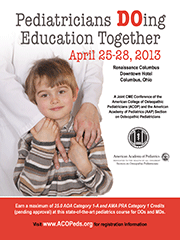
Pediatricians DOing Education Together
April 25-28, 2013
Renaisance Columbus Downtown Hotel
Columbus, OH
FREE Handbook!
Now Available!
Vaccine Handbook
By Dr. Gary Marshall
TO PLACE YOUR ORDER
(Please add "Vaccine Handbook" in the subject line and include your full name and mailing address.)
NOW AVAILABLE!
Nutrition CD Available
FREE OF CHARGE
Provided by Abbott Nutrition
An Ounce of Prevention
TO ORDER YOUR COPY

Prescription Pads
Available
TO ORDER YOUR Rx PAD
(Limit one per person)