
THE QUARTERLY PUBLICATION OF THE AMERICAN COLLEGE OF OSTEOPATHIC PEDIATRICIANS
Spring/Summer 2020 Issue
 to Home Page
Student Perspectives
A Beacon of Hope During COVID Times | Students Connect with Families: Response to Pandemic Isolation
A Beacon of Hope During COVID Times
By Gabriela Lins, OMS-IV
Osteopathic Medical Student, Class of 2020
Dr. Kiran C. Patel College of Osteopathic Medicine
Nova Southeastern University
March 17, 2020
St. Patrick’s Day, a day typically celebrated with commemorative shiny green beads, beer, and all things Irish. However, today had a particularly different feel. As I pulled into the parking lot of my rural clinic rotation, my mind was in a flurry of uncertainty. Thoughts raced through my head as the doubt seeped in: was I a possible asymptomatic carrier? Could I be exposed? Would I receive proper protective equipment?
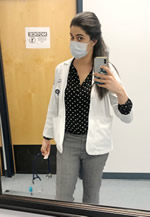 |
| Last workday at the rural clinic |
Other classmates of mine had already been pulled from their rotation sites and yet here I was, going in to see the particularly vulnerable: underserved patients over 65 with multiple chronic conditions. Anxiety gripped me as I worried whether I was doing more harm than good by being at the clinic. As I waited with my classmate in the attending’s office to start the day, my fear and anxiety quickly dissipated. The attending, a mother of two in her early 30s, came in wearing her green scrubs and with a look of determination in her eyes. Her scrubs were the only green any of us wore that day ironically.
She told us that protocols were evolving daily and that the clinic was doing its best to screen and identify high-risk patients. Patients with respiratory symptoms were exclusively seen in the first patient room in order to minimize exposure to healthy patients.
We wore masks all day and washed our hands vigorously between patient visits. I saw about fifteen patients that day – most did not fully understand the pressing need to be social distancing or staying home and others were moments away from ending up in the ER.
My brief time at the clinic highlighted to me that the already vulnerable were going to be disproportionately affected by this virus as many of them could ultimately succumb to complications from their chronic diseases long before getting infected by COVID. We worked tirelessly that day to fill prescriptions, educate patients on the effective hygiene measures to implement at home, and provide medical care to the vulnerable and uninsured.
As I watched my attending fearlessly rise to the challenge and tackle the day in the midst of the chaos, I understood that physicians do not have all the answers. However, kindness and a commitment to doing the best for patients are guiding principles that serve as a beacon during uncertain times.
At the end of the workday, my classmate and I received an official email from our school stating that we were no longer allowed to return to the rotation site. Over the next two months, my in person clinical rotation transitioned to online. My medical school released a public health curriculum that was timely and pertinent. I was able to keep up with current COVID-19 events and learn about the pathogenesis of the virus, contact tracing, social distancing, and other public health strategies used to keep medical personnel and the general public safe.
Honestly, I never believed that the last patient I would treat as a medical student would be an adult. Even though all my patients at this clinic were an average of 65 years and older, the strategies I use to educate pediatric patients and parents still hold true with this population. I approach each patient encounter with the following principles: humility, compassion, empathy and a commitment to lifelong learning.
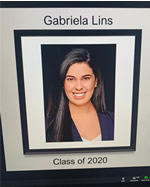 |
| Zoom graduation ceremony |
Humility is necessary to admit you don’t have all the answers. In times of uncertainty, compassion is essential to assuage the fears of your patient and your own. Empathy allows you to understand the very real needs of individual patients and design a plan that is unique for them. In learning, by approaching the process with the curiosity of a child, we can commit to a lifelong journey in the pursuit of knowledge.
Two weeks ago, I recited the official osteopathic oath and was conferred into the profession. The words I stated could not hold truer:
“I will be ever alert to further the application of basic biologic truths to the healing arts and to develop the principles of osteopathy which were first enunciated by Andrew Taylor Still.”
As 30,000 medical residents start residency in the next month, my anxiety and concern are washed away and replaced with the conviction that even in the midst of uncertainty, physicians around the country will respond to the call with humility, compassion, empathy and an unwavering commitment to lifelong learning.
Students Connect with Families: Response to Pandemic Isolation
By Michael Petrus-Jones
PGY-1, Pediatrics L.E.A.D. Program
Baylor College of Medicine
Texas Children's Hospital
In one week of March, Cook Children’s Hospital in Fort Worth, TX had seven consults for suspected non-accidental trauma and two confirmed deaths as a result of child abuse. They usually have an average of six total deaths from child abuse over the course of a year1. Across the country, hospitals are seeing similar statistics with increased morbidity and mortality from child abuse complications2 during social isolation measures due to the SARS-CoV-2 (coronavirus) pandemic. This uptick in the prevalence of child abuse is suspected to be caused by increased caregiver stress with children unable to attend school, financial stress of lay-offs and furloughs, and lack of adequate child care3. Although there seems to be increased severe complications and deaths from child abuse, there has been an alarming drop in calls to abuse hotlines3. This implies that families are suffering in silence and caregivers aren’t reaching out to get the help that they need.
At our Health Science Center Pediatrics Clinic, the chief pediatrician, Priya Bui, DO, expressed concern about increased rates of child abuse, social isolation of families, and possible spikes of mental illness exacerbations due to increased stress and emotional turmoil. All of the University clinics were forced to close their doors to in-person visits due to growing concern of the spreading contagion. Because families were not getting the usual surveillance and in-person, one-on-one collaboration with a provider, we decided to organize a volunteer effort to reach out to caregivers and parents of those most at-risk to perform a virtual “check-in”. As a new pediatrician about to start residency, I was searching for a way to help our community during this stressful time. Dr. Bui and I worked together to come up with a plan to reach out to families.
A group of 12 graduating medical students pursuing pediatrics and family medicine was recruited in March to call caregivers and parents of new infants ages two to six months, toddlers ages 18 months to three years, and pre-teens/teenagers with previous psychiatric diagnoses. A remote database with names, ages, and phone numbers was created with a suggested script for each age group and an encounter note associated with each child. Students reached out to caregivers and inquired about increased stress, concerns about their children, access to online schoolwork, child behavior, and coping. If parents expressed a medical concern, students were able to flag the encounter for virtual follow-up with a provider within 48 hours and students had immediate access with a pediatrician on-call for urgent concerns.
Many caregivers and parents expressed sincere gratitude to our students for taking the time to check on their families. Some of them took the time to send thanks to our clinic staff and faculty ensuring that the students knew that their time and effort was appreciated. Many of our families didn’t know that telehealth appointments were still available to them and without our calls would not otherwise have known to reach out with medical concerns. Some parents were able to share their emotional concerns with our students during the calls and felt heard and supported. With the huge success of this project, it is being transitioned to incoming 4th year students with a staggering 40 volunteers signed up to help.
Although the clinic will be re-opening its doors soon to some appointments, including well child checks, this project will continue so that families who are still isolating at home will know that the clinic and its staff and volunteers are still here for them if they need us. As a newly minted physician and incoming intern in pediatrics, I am proud to have had the opportunity to serve our local community in a way that not only put families at ease but improved health and wellness of our community’s children. I will begin residency as part of the Primary Care L.E.A.D. (Leaders Evaluating and Addressing Disparities) pediatrics program at Baylor College of Medicine in Houston and I hope to continue to serve my community in similar ways as I transition into my role as a primary care pediatrician.
References
- Cook Children’s Sees Spike in Child Abuse Cases Likely from COVID-19 Stress by Natalie Solis and Gerardo Martinez
- Stay-at-home Orders Amid Pandemic Create a "Perfect Storm for Child Abuse," Welfare Worker Says by CBS News
- Child Abuse Fears Increase as Families Isolate During Coronavirus Pandemic by Erin Donaghue
- With Kids Stuck at Home, ER Doctors See More Severe Cases of Child Abuse by Samantha Schmidt and Hannah Natanson

PULSE IS
AVAILABLE ON YOUR SMARTPHONE
AND TABLET!

JOIN ACOP TODAY!

SAVE THE DATES!
 |

For support and exhibitor information, contact
Dana Gibson